Does One Size Fit All? Can AI Really Fix a Broken Process?
What if the task being automated should not exist?

Artificial intelligence can improve a process without improving the system around it. The model performs the task more quickly, the queue becomes shorter and the project appears successful, while the assumption that created the work remains untouched.
The Toothache and the Form

Artwork from Classroomclipart.com
Mark has had a toothache for three days. He has tried to ignore it, but the pain is beginning to affect his work. He finds a dental clinic and asks for an appointment. Before he can be seen, he has to register, so the clinic emails several forms which he can return by post or bring with him on the day.

Artwork from Dreamstime.com
Mark arrives with the completed forms. A clerk reads the handwriting and enters the information into the dental record system, then the appointment continues.
Several months later, Mark changes jobs and moves across town. He contacts the clinic to update his address. The clinic sends him another copy of the information it already holds, which he corrects and returns so that a clerk can enter the changes again. Mark is one patient. The clinic has thousands.
The Queue Beneath the Desk
The dental record system makes each update slow. Forms accumulate, and clerks spend evenings and weekends transferring information from paper into the database.
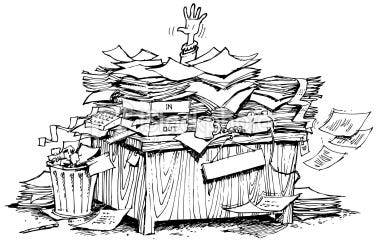
Clerks overwhelmed with paperwork
The backlog is expensive. Management can see it in overtime, delayed records and frustrated staff. Data entry has become the visible bottleneck, so the clinic reaches for artificial intelligence.
The Machine Reads the Paper

The light-bulb moment
The proposed system uses computer vision and handwriting recognition to scan the forms. A clerk places a document into the machine, the software extracts the text and the information enters the dental database.
The clinic is prepared to pay for the integration because the calculation appears straightforward. Fewer hours spent on manual entry should eventually recover the cost of the system.
The machine works. Forms move more quickly, the backlog falls and management can point to a successful artificial intelligence project. The patient still receives a document containing information the clinic already has, edits a copy and returns another copy. The clinic still has to translate the same facts from one representation into another.
Artificial intelligence has accelerated the step. It hasn’t asked whether the step should exist.
The Step That Should Disappear
A different design could give Mark a secure link to the information already held about him. After verifying his identity, he could update the address directly. The system could validate the format, record who made the change and flag unusual updates for review. The clinic would no longer need to print, post, scan and transcribe the same information.
This wouldn’t require a sophisticated learning model. It would require a better digital process.
Artificial intelligence is often applied to the most visible pain in a workflow. The paper is difficult to read, so we build a machine that reads paper. The queue is long, so we build a system that moves the queue faster. Yet the paper and the queue may be symptoms of the same deeper problem. The information has no direct route from the person who knows it to the system that needs it.
Computer vision can bridge that gap. Process design can remove it.
The OCR system may still be useful where paper is unavoidable, handwriting carries clinical meaning or documents arrive from organisations outside the clinic’s control. The mistake isn’t using artificial intelligence. It is assuming that the existing task deserves to survive.
When Automation Preserves the Error
A process contains assumptions about who enters information, where it is stored and how responsibility moves from one person to another. Automation inherits those assumptions. If the workflow asks a clerk to copy information from a form, a machine can learn to perform the copying without questioning why the form exists.
Once the copying becomes cheaper, the organisation may become less likely to redesign the process because the visible cost has disappeared. Automation makes the old structure easier to tolerate.
This is one of the quiet dangers of adding artificial intelligence to legacy systems. The technology is judged by the step it improves rather than by the process it preserves. A faster wrong step can look like transformation.
The result may be more efficient, but it remains shaped by the limits of the older system. Duplicate records are still possible. Errors may move from manual entry into automated extraction. Responsibility can become harder to locate because the machine now sits between the document and the database. Before automating a task, the organisation has to understand why the task exists.
The Country That Removed the Form
With a population of about 1.3 million people, Estonia has built much of its public administration around digital identity and interoperable registries. The lesson is not that every country or company should copy Estonia exactly. Scale, law, history and public trust differ.
The useful principle is that information should move before intelligence is added to it. A birth recorded by a hospital can pass into an authorised population system without requiring the family to reproduce the same event across several offices. Citizens can use a digital identity to access services, while approved professionals retrieve relevant information without asking the person to carry another copy between institutions.
The process begins with a shared digital architecture. Artificial intelligence can then work with information that is current, structured and available under clear permissions. Without that foundation, the model may be asked to infer around missing records, inconsistent formats and delays created by the organisation itself.
A learning system does not repair a fragmented information environment merely by entering it. It learns the fragmentation.
The Infrastructure Below Intelligence
Artificial intelligence depends on more than data scientists and machine learning engineers. It also needs product managers who can define the real problem, operations teams who understand how the work moves, security specialists who can protect the information and domain experts who can recognise when the system has misunderstood the case.
The shortage is therefore larger than a shortage of model builders. An organisation may recruit a brilliant machine learning specialist and still fail because the data cannot be accessed, the workflow has no owner or the system has nowhere sensible to place its prediction.
Digitally mature companies have an advantage because the foundations already support experimentation. Their data moves through known systems, their teams are accustomed to software changing the process and employees can develop technical skills inside work that already gives those skills somewhere to go.
Other organisations often search for a finished expert who can arrive and supply the missing future alone. That person does not exist. The capability has to be grown across the system.
Before the Model
A business or government preparing for artificial intelligence should begin with ordinary questions.
Where does the information enter?
Who copies it?
How many versions exist?
Which step introduces delay?
Who owns the process from beginning to end?
What could be removed before anything is automated?
Only then should the organisation ask whether the remaining problem requires pattern recognition, prediction or another form of machine learning.
Artificial intelligence is powerful when uncertainty remains after the process has been made clear. It can read an unavoidable document, detect an unusual case or help a person decide where attention belongs. It is less useful when asked to preserve paperwork with greater sophistication.
The machine can learn to read the form. The better system may no longer need the form.
Comments