Does Your Company Need an AI Strategy?
What is left of an AI strategy once the business has chosen its direction?
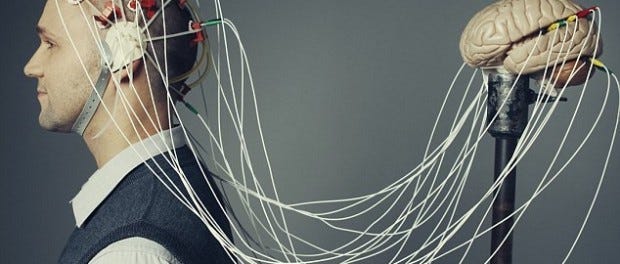
A company does not need artificial intelligence for its own sake. It needs a reason to change.
A business makes products or provides services, then organises people, money and information around that work. Artificial intelligence enters as a new capability. It can recognise patterns, estimate outcomes, rank options and automate repeated decisions, but none of those abilities supplies a direction.
Technology expands what the company can do. Strategy decides which possibilities should matter.
The Tool With No Direction
It is easy to confuse a list of artificial intelligence projects with an artificial intelligence strategy. A company can build a chatbot, predict customer demand, automate document processing and recommend products. Each project may be useful, yet together they may still point nowhere.
Strategy is not the number of intelligent systems inside the organisation. It is the choice about where the organisation will compete, which capability must become different and what the company is prepared not to build. Artificial intelligence can support that choice. It cannot make the choice meaningful.
The first question should therefore not be where the company can use AI. It should be what the company is trying to change.
The Plug Test
The commercial internet provides a useful precedent. Macy’s added an online shop to a retail institution that already existed. The website became another entrance into the same business, while stores, staff, stock and an established distribution network remained central.
Amazon began with the network much closer to its foundation. The catalogue, transaction and customer relationship were designed around the internet. Physical warehouses and delivery systems became essential later, but they grew around an organisation that was already native to the network.
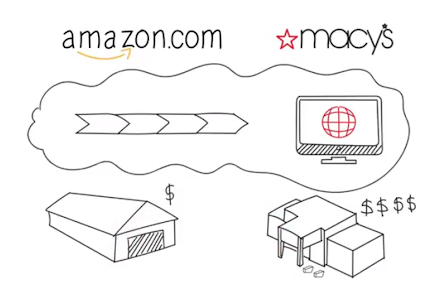
The internet entered Macy’s as a channel and Amazon as part of the foundation
Imagine disconnecting both companies from the internet. Macy’s would lose an important sales channel, but the underlying retail business would remain recognisable. Amazon would lose much of the environment through which its market is coordinated.
The difference is not that one company used technology and the other did not. It is where the technology was allowed to sit. Macy’s used the internet to extend its existing structure. Amazon allowed the network to shape the structure itself. Artificial intelligence presents the same choice.
Four Different Businesses
A company can use artificial intelligence to automate part of its work. Repetitive processing may become cheaper and faster, but the organisation still has to decide what happens to the people, responsibilities and exceptions left behind. It may instead use AI to understand customers more closely. Patterns in behaviour can reveal unmet demand, provided the business has product teams capable of turning those patterns into something useful.
Personalisation creates another organisation again. Recommendations, pricing and service can change from one person to another, but the company must decide what information it is willing to collect and how much control the customer retains. A business using AI to compete more aggressively faces a different pressure. A better prediction or faster decision may draw customers away from another company, but the organisation must be able to absorb the demand it creates.
These are not four versions of the same strategy. The technology may be similar, but the data, workflows, operating models and consequences are not. They are four different businesses.
The Face in the Lobby
Suppose the company’s goal is to sell more products to existing customers. A facial recognition system in the lobby may be technically impressive. It may identify returning customers and greet them by name, while also requiring new cameras, consent processes, security controls and a convincing reason for customers to accept being recognised.
None of that proves it will help the company sell the next useful product. A simpler recommendation model based on purchase history may fit the strategy better. So might improving the quality of customer data or giving staff a clearer view of the existing relationship.
The most advanced project is not automatically the most strategic. A strategy earns part of its value through refusal because it tells the organisation which clever things do not belong.
Without that discipline, artificial intelligence becomes expensive theatre. The company demonstrates that the technology can work while leaving the business unchanged.
What Changes After the Prediction
A useful artificial intelligence project has a destination. If a model predicts that a customer may leave, someone must know what action follows. If it forecasts demand, the supply chain must be able to respond. If it recommends a product, the company needs to know whether the recommendation improved the relationship or merely increased the number of messages sent.
The prediction is not the outcome. The business process surrounding it determines whether the system creates value, which means an artificial intelligence strategy must extend beyond the model. It has to include the data used to make the decision, the person or system receiving the result, the action taken and the evidence returned afterwards.
Without that route, the company has built intelligence with nowhere to go. The model becomes another report, and the organisation remains exactly as it was.
The Strategy Beneath the Strategy
A company may need a temporary artificial intelligence strategy because the capability is new, unevenly understood and easy to misuse. A separate strategy can focus attention, establish technical standards, identify useful data, create governance and prevent departments from purchasing disconnected systems that cannot work together.
That separate programme is not the final destination. Artificial intelligence should eventually become part of how the company executes its wider strategy. Marketing, operations, customer service and product design should not pursue independent intelligent futures. They should use the capability where it changes the choice the organisation has already made.
The internet followed a similar path. Companies once spoke about internet strategy because the network was new enough to require separate attention. Over time, the distinction became harder to maintain. A business strategy that ignored the internet simply became an incomplete business strategy.
Artificial intelligence may follow the same movement. The separate strategy is useful while the organisation is learning where the capability belongs. If it succeeds, the adjective begins to disappear.
The Direction Before the Engine
Artificial intelligence can help a company lower costs, understand customers, create products or redesign the organisation around new kinds of decisions. It cannot tell the company which of those futures is worth pursuing.
That remains a human choice, shaped by the market, the purpose of the business and the consequences the organisation is prepared to own. The company does not need artificial intelligence to tell it where to go. It needs to know where it is going before artificial intelligence makes every direction look possible.
Comments