Preparing Your Business for Artificial Intelligence
What should the first AI project teach the organisation?

A survey of marketing executives found a familiar contradiction. Many expected artificial intelligence to transform their industry, yet remained reluctant to begin. The hesitation is understandable.
Some companies already have artificial intelligence close to the centre of the business. Search, recommendations and automated decisions are part of how companies such as Amazon and Google organise their products. Other organisations have large stores of data and are beginning to build specialist teams around them. They are prepared to learn through investment, experimentation and failure.
A third group can see that artificial intelligence matters but cannot tell where the first step belongs. The field appears too large. Every vendor offers a platform, every demonstration looks impressive, and the organisation is left trying to choose a future before it has found a useful problem in the present. Preparation begins somewhere smaller.
The First Door
Imagine an airline that sells tickets across the country.
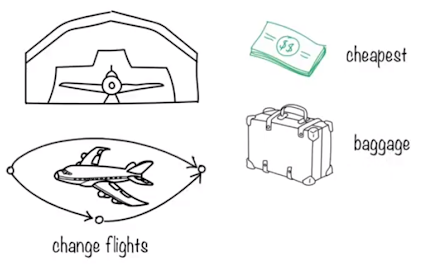
Its customers ask many of the same questions.
- What is the cheapest way to reach a destination?
- How can a booking be changed?
- How much baggage is allowed?
- What happens after a missed connection?
- Which documents are required?
The answers may already exist across web pages, policy documents, booking systems and the experience of customer service staff. The difficulty lies in finding the right answer quickly and placing it in front of the customer through the channel they have chosen. A chatbot is one possible first project.
Conversation isn’t easy. Language is full of ambiguity, and a customer with a disrupted journey is not a clean software input. The value lies in the shape of the problem. The organisation already has repeated questions and answers that can be inspected. The system can begin with a narrow set of requests, then return anything uncertain to a person. The door is small enough to watch.
The Smallest Useful Machine
A useful pilot should solve a real problem without placing the whole organisation behind an untested system. A customer service chatbot can begin with a bounded collection of common questions. It might retrieve baggage rules, explain how to change a flight or direct a customer towards the correct part of the booking process.
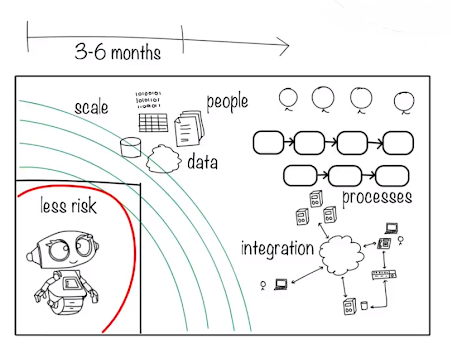
This creates several advantages.
- The business can begin with a problem it already understands.
- Much of the source material already exists.
- The system can be isolated from critical operations.
- Uncertain requests can be escalated to staff.
- Customer reactions can be observed directly.
- The project can be delivered in stages rather than as one large transformation.
The important word is useful. A chatbot that only repeats marketing language will teach very little. One that reduces avoidable calls, shortens waiting times or helps staff locate policy information begins to reveal where artificial intelligence belongs inside the work.
The first project should be small enough to fail without stopping the company and important enough that success can be recognised.
The Organisation Answers Back
The chatbot is not only a service for customers. It is also a test of the organisation surrounding it. A customer may ask a simple question and reveal that the company has three different answers stored in three different places.
The system may fail because the language model is weak. It may also fail because the policy is unclear, the data is inaccessible or the booking process crosses too many disconnected systems. Artificial intelligence often exposes these older fractures rather than creating them.
The organisation may discover that its documents are not maintained consistently, that nobody owns a particular rule or that staff rely on local knowledge which has never been written down. The machine appears confused because the business has not resolved the question for itself.
That failure is useful. The pilot begins to show which data needs to be collected, which processes need simplifying and where responsibility currently disappears between departments. The first AI system may improve customer service, but its deeper value is that it makes the organisation answerable to its own structure.
New Measures
A conventional customer service operation may be measured through call volume, waiting time and average handling time. A chatbot creates different questions.
How often does it understand the request?
How often does it provide the correct answer?
Which questions require escalation?
Do customers repeat themselves after transfer to a person?
Which policies produce the most confusion?
Does the system reduce work, or simply move the work elsewhere?
These measures matter because a high rate of automated responses doesn’t prove that the experience improved. A chatbot can close many conversations by misunderstanding them efficiently. The organisation therefore needs to measure the outcome rather than the appearance of automation.
This is one of the most valuable lessons a pilot can provide. Artificial intelligence changes what the business is able to observe, but it also demands more care about what the chosen number actually represents.
The People Around the Pilot
Employees will not experience the system as an abstract technology. They may see a tool that removes repetitive questions, or a machine being trained on the work that gives their role value. Both interpretations can exist at the same time, and a pilot creates room to understand that response before artificial intelligence spreads across the company.
Staff should help define the common questions, review answers and identify the cases that require judgement. They often know where the documented process differs from the process that actually works. Their involvement is not merely a way to encourage acceptance. It improves the system.
The employee who has handled hundreds of disrupted journeys understands distinctions that may not appear in a policy document. That experience helps define the border between a request that can be automated and one that should remain with a person. The pilot should make that border visible.
The Vendor Is Not the Strategy
A vendor can reduce the cost of beginning. A chatbot provided as a service may remove the need to build the language interface, hosting and monitoring from the ground up. That convenience is useful, although it can make the first technical choice feel like the strategy itself.
Before selecting a vendor, the organisation should know who owns the conversation data, how the system connects to internal records, which parts can be exported and what happens if the service is later replaced. A platform containing several artificial intelligence services may make future experiments easier while making the business increasingly dependent on one provider.
The correct choice is not necessarily the platform with the longest list of features. It is the one that lets the organisation learn without making that learning difficult to carry elsewhere.
The Pilot Is a Mirror
A well-chosen first project can answer questions that no presentation about artificial intelligence can settle. It can show how much usable data the business actually has, whether policies are consistent, whether employees trust the new workflow and whether the chosen metric describes the outcome that matters.
It can also show how the organisation responds when the machine is uncertain. That may be the most important result.
Preparing a business for artificial intelligence is not the act of installing an intelligent component. It is the work of building a place where that component can fail visibly, hand judgement back to a person and leave enough evidence for the next version to improve.
The first system should not prove that the machine is ready. It should reveal whether the organisation is.
Comments