How AI-Based Companies Will Eliminate Your Business
What happens when artificial intelligence changes what a company needs to contain?

When the internet became commercially useful, Macy’s and Amazon both used it, though not in the same way. Macy’s added a website to a retail business that already existed. The stores, stockrooms, staff and supply chain remained at the centre, while the internet became another entrance.
Amazon began with the network much closer to the centre. Its catalogue, transactions and customer relationships were designed around a connected system from the beginning. Physical warehouses and logistics later became enormous parts of the company, but they grew around a business already native to the internet. Macy’s used the network as a channel. Amazon used it as a substrate.
The Plug Test
Imagine that the internet disappears.
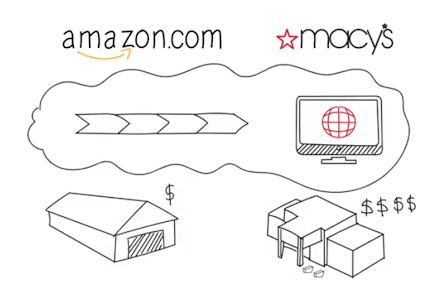
Macy’s would lose an important sales channel, but the underlying retail institution would still be recognisable. Stores could open, staff could serve customers and stock could continue moving across a physical network. Amazon would lose the environment in which its market is coordinated. The catalogue, search, recommendations, payments and much of the relationship between buyer and seller would collapse together.
The test isn’t meant literally. Amazon already owns substantial physical infrastructure, and Macy’s depends heavily on digital systems. The useful distinction lies beneath those details. Ask what remains when the technology is removed. If most of the business survives, the technology has been attached to the organisation. If removing it dissolves the organisation’s way of operating, the technology has become part of its foundation.
Artificial intelligence is beginning to create the same divide.
The Clever Addition
A conventional company can add artificial intelligence around the edges of its existing structure. A retailer might place a chatbot on its website, use a model to recommend products, forecast demand or identify customers likely to leave. It may automate parts of stock management or use computer vision to inspect goods.
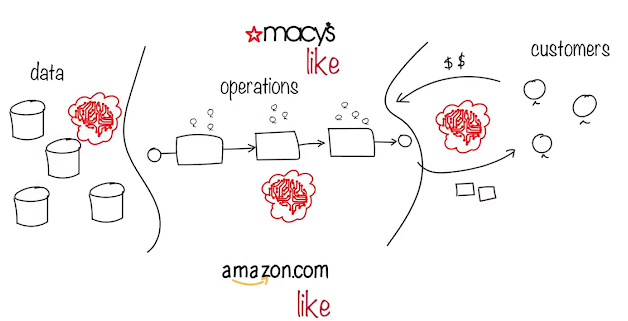
These changes can be useful. They may lower costs, improve service and make decisions faster without altering the institution beneath them. The same departments still exist. Information follows the same routes. The model produces a score, then the established process decides what to do with it. Artificial intelligence has improved the machinery without changing the shape of the machine.
An AI-native company begins with a different question. It asks which parts of the organisation exist because people cannot examine every case, coordinate every participant or update every decision continuously. Once prediction and pattern recognition become cheap enough, some of those boundaries stop looking permanent.
The question is no longer simply where AI can be added. It becomes what the business would look like if prediction had been present from the beginning.
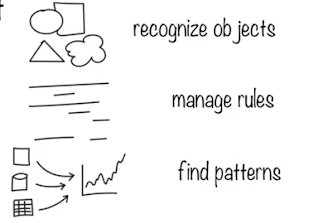
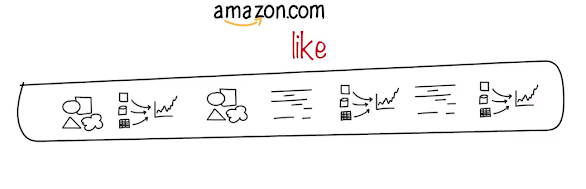
Artificial intelligence can recognise objects in images, estimate relationships inside complex data and search volumes of information that exceed human attention. In one company, those abilities support the employees and processes already there. In another, they help determine which employees, departments and processes need to exist at all.
The Company in Pieces
Insurance provides a useful example. The premium charged for motor insurance is partly an estimate of risk, shaped by location, driving history, age, vehicle type, credit information, weather and many other variables.
A traditional insurer gathers the information, estimates the risk, produces a quote, collects payment, manages the policy and handles claims inside one organisation. The company appears to be one thing because all those functions sit behind one name.
Artificial intelligence makes the joins easier to question. A specialist company could focus entirely on risk, combining information from credit agencies, crime records, weather services, vehicle data and other sources to estimate the probability of loss for a person, vehicle or journey.
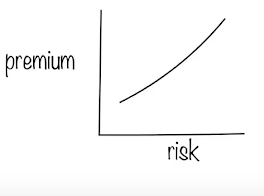
That company wouldn’t need to sell insurance directly. It could provide the risk estimate to other businesses. Another company might specialise in generating quotes, another in managing payments, another in inspecting images submitted during a claim. A separate service could identify suspicious patterns across claims. Each organisation could become narrow, technical and unusually good at one part of the old insurer.
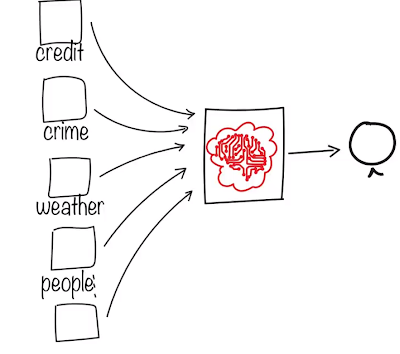
The original company was organised partly around the difficulty of joining these functions. Once software can coordinate them, the boundary holding the company together becomes negotiable.
The Company Between the Companies
A collection of specialised services still has to feel like one business to the customer. Someone must gather the information, call the correct services, pass state between them, combine the results and present one coherent outcome.
That creates another kind of company. It may own little of the underlying capability. It may not calculate the risk, process the payment or inspect the claim itself. Its advantage lies in deciding which service handles each part and making the separate systems appear continuous.
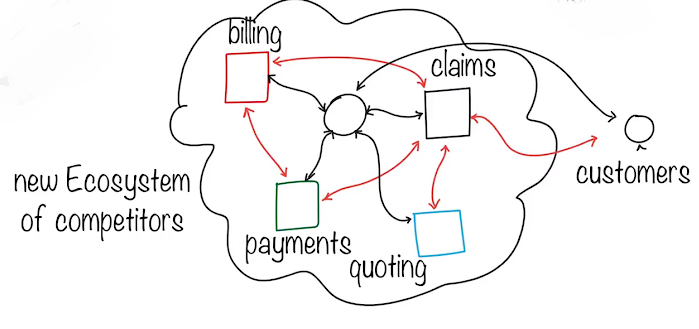
The customer sees one interface. Behind it sits an organisation assembled from other organisations. This orchestration layer may become more powerful than any one specialist because it owns the customer relationship, observes the complete transaction and can replace one supplier without asking the customer to move. The specialists become components inside an experience controlled elsewhere.
The threat to an incumbent is therefore deeper than automation. A new entrant doesn’t have to reproduce the old organisation department by department. It can decompose the service, select the strongest available component for each function and rebuild the customer experience around a smaller centre.
The old firm carries the history of how the work used to be joined. The new firm carries only the parts that still need joining.
The Cost of the Old Shape
An established company may have skilled people, valuable data and loyal customers. It may also have processes designed around technical limits that no longer apply. A department may exist because information once moved slowly. A manual review may remain because the underlying data has never been made available in one place. A product may bundle several services because separating them used to create too much administrative cost.
Artificial intelligence can reduce some of that coordination cost, but adding a model to every department may only make the old shape more efficient. It does not ask whether the shape should survive.
A company built later has no obligation to preserve it. It can begin with the bottleneck rather than the department, automate the predictable work, send exceptions to a person and join the result to another service. The organisation then grows around the uncertainty that remains rather than around every task inherited from the previous institution.
This produces a different cost structure, though the more important difference is architectural. The new company doesn’t carry every part of the old company. It carries the decisions.
The Business After the Business
The title of this essay is deliberately severe. Artificial intelligence will not eliminate every established company, and attaching AI to an existing process isn’t automatically a mistake. The threat is more precise.
A company can continue operating while the valuable decisions inside it move elsewhere. The customer relationship may move to a platform. Risk assessment may move to a specialist. Recommendations may come from a model supplied by another company. Claims may pass through an automated service. The incumbent remains visible while the systems determining price, access and experience are gradually removed from it.
Eventually, the organisation may still make the product while no longer deciding how the market encounters it. That is how an AI-based company can eliminate a business without destroying the company that carried its name.
It changes what the company is needed for.
Comments