Healing Back Pain: The Mind Body Perception
What if pain is real without being a faithful map of damage?
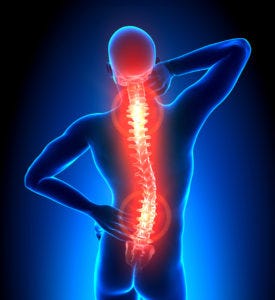
John Sarno’s provocation is simple. We are not made of papier-mâché. The human body is built to move, adapt and heal, yet persistent pain can make an ordinary movement feel capable of exposing some hidden structural weakness. The fear is understandable because pain feels like evidence. When it continues, the body appears to be reporting that something remains damaged.
Pain, however, is not a scan of the tissue. It is a perception produced by the nervous system. The signal can be accurate without being complete.
The Alarm That Stayed On
Chronic pain is usually understood as pain that continues for three months or longer. It may be mild or severe, constant or intermittent. What makes it chronic is not simply its intensity, but the way it persists beyond the period in which an injury would normally be expected to heal. Anyone who has lived with it knows how quickly pain can narrow a life. Movement becomes a calculation. Sleep becomes fragile. Work, travel and ordinary plans begin organising themselves around the next flare.
Pain can arise from damaged tissue, inflamed joints, irritated nerves, muscular injury or disease, and those possibilities require proper medical assessment. Persistent pain can also continue after the original tissue has healed, move between regions or remain severe when no single structural cause explains it. That doesn’t make the pain imaginary. Pain and damage are not the same thing.
The Scan and the Story
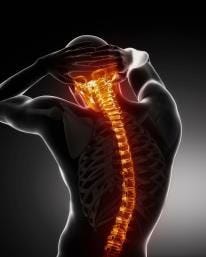
Back pain often begins a long journey through medicine. A patient sees a doctor, then a physiotherapist, rheumatologist, neurologist or surgeon. Images are taken. A disc bulge, degeneration or another irregularity is found, and the picture appears to provide the answer. Sometimes it does.
The difficulty is that scans also find structural changes in people who have no pain. In a widely cited New England Journal of Medicine study, researchers examined lumbar MRI scans from people without back pain and found disc bulges and protrusions in many of them. The image showed a physical difference. It did not show whether that difference hurt.
This doesn’t make imaging useless. A scan can reveal fractures, tumours, infection, nerve compression and other conditions that change treatment. It does mean that an abnormality on a screen is not automatically the source of the experience. The scan is part of the story. It is not the pain itself.
The Part Sarno Saw
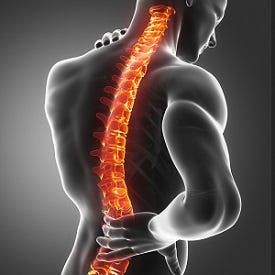
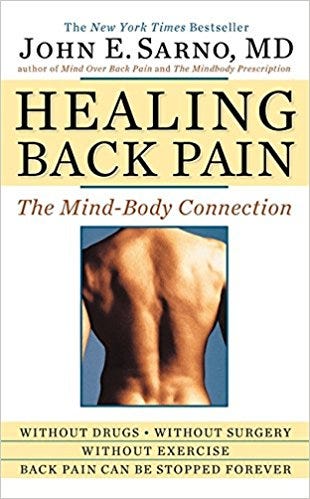
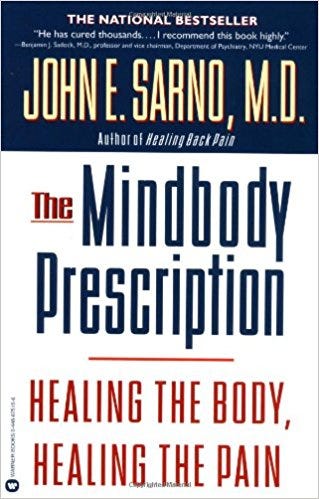
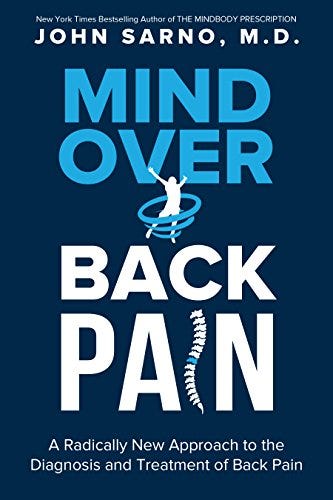
Sarno worked with patients whose symptoms had not responded as expected to conventional treatment. He noticed that many were anxious, perfectionistic, highly responsible or accustomed to suppressing anger and distress. His central insistence was important. The pain was real, but its cause might not be where everyone was looking.
Sarno called his model Tension Myositis Syndrome. He argued that repressed emotions, particularly rage, could generate physical symptoms as a distraction from feelings the unconscious mind considered more threatening than pain. He proposed that the autonomic nervous system reduced blood flow to muscles, nerves and tendons, creating mild oxygen deprivation and pain. That mechanism remains a hypothesis rather than an established explanation for chronic pain, and repressed rage cannot safely be treated as the universal cause of back pain, migraine, bowel symptoms, fatigue, anxiety and the many other conditions Sarno placed beneath the same name.
The larger challenge survives the theory built around it. The body is not separate from the conditions in which it lives. Stress, fear, memory, sleep, mood and expectation can change the way pain is produced and experienced. The mind does not invent the pain. The nervous system constructs it from more than tissue alone.
The Rooms Below
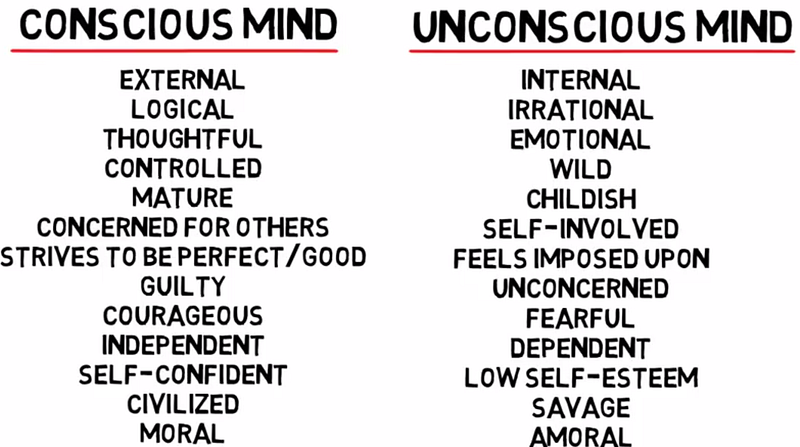
The conscious, subconscious and unconscious are often drawn as three separate rooms.
- The conscious mind contains what we can notice and describe.
- The subconscious holds material that can be brought into awareness.
- The unconscious names processes that remain outside direct access.
This is a useful picture, but not a literal map of the brain. The boundaries are not clean. Perception, memory, emotion and bodily regulation are distributed across systems that continue working whether or not we are aware of them.
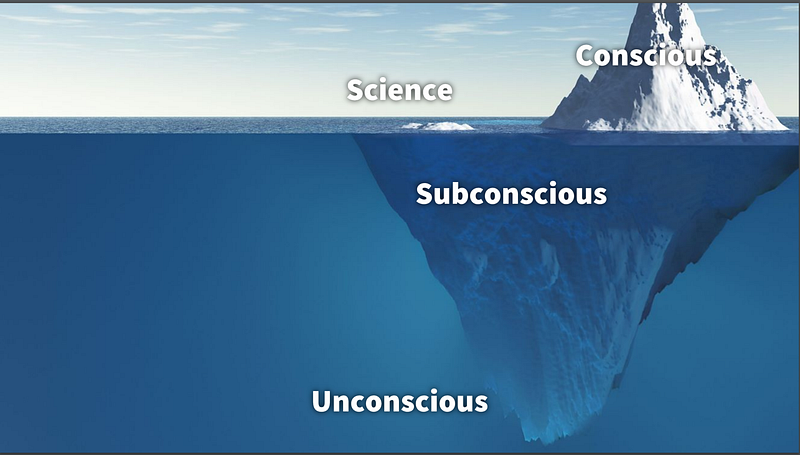
The unconscious is the ocean from which all forms of consciousness are born.
A dry mouth before speaking in public is not imaginary. Neither are butterflies in the stomach, a heart racing during a frightening film or the sleeplessness produced by a thought that will not settle. The event may begin in interpretation, but the response is physical, and pain can move through the same border. Sarno often saw recurring traits among his patients.
- Perfectionism
- People pleasing
- Persistent anxiety
- Stoicism
- Low self-esteem
These traits are not a diagnosis, and they do not prove that someone’s pain is emotional. They may, however, create a life in which pressure is absorbed quietly and the body remains in a prolonged state of protection.
A Body That Learns
The nervous system changes with experience. London black-cab taxi drivers have shown structural differences in the hippocampus, a region involved in spatial memory, after years of navigating a complex city. That finding does not prove Sarno’s theory. It reveals something more basic. Repeated experience can alter the system doing the experiencing.
Pain can also be learned. A movement that once caused injury may continue to trigger fear after the tissue has recovered. The person moves less, becomes weaker and watches the body more closely. Each sensation gains importance, and the nervous system receives repeated evidence that the movement remains dangerous. The loop reinforces itself.
This is why reassurance, education, gradual activity and psychological support can matter alongside physical treatment. They do not work by pretending the pain is absent. They help the nervous system revise what it has learned to protect against.
The Map Is Not the Wound
Medicine often treats the body as a machine, and the analogy is useful. A fracture can be stabilised. A compressed nerve can sometimes be released. An infection can be treated. A damaged joint can be repaired or replaced. The model becomes weaker when every persistent symptom is assumed to be a broken part waiting to be found.
The alternative is not to abandon the body for the mind. It is to stop pretending they arrive separately. Persistent pain can include tissue injury, nerve sensitivity, stress, fear, disrupted sleep, learned avoidance and social pressure at the same time, with the proportions differing from one person to another. Treatment therefore has to remain broad enough to include movement, medical care, education and psychological support without reducing the person to any one of them. A structural explanation can be incomplete. An emotional explanation can be incomplete too.
The practical question is not whether the pain is physical or psychological. Pain is already both an experience of the body and an interpretation by the nervous system. The body can heal while the alarm continues, and recovery may begin when the alarm is understood as something the system learned to produce rather than proof that the body has become too fragile to move.
Comments